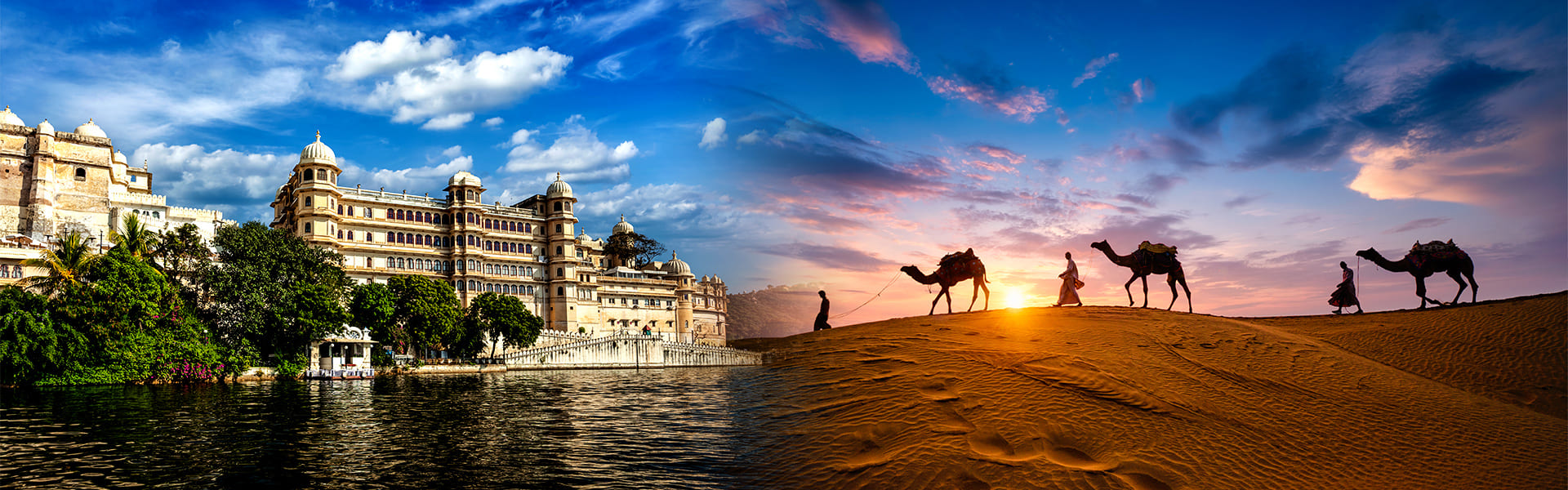
Rajasthan is India at its most theatrical — a land of warrior kings, ethereal palaces, and golden deserts that seem to glow from within. No other state in India offers such a concentrated wealth of history, art, and architectural grandeur.
From the rose-pink city of Jaipur to the indigo-washed walls of Jodhpur, from Udaipur's lake palaces that seem to float between sky and water to Jaisalmer's sandcastle fort rising from the Thar Desert — every city is a masterpiece with its own personality and palette.
This is a land where heritage hotels are actual palaces, where dinner can be served in a centuries-old fort, and where a camel safari through the dunes reveals a sky so full of stars it seems painted.
Six reasons Rajasthan will steal your heart — and your itinerary
A hilltop fortress that took 100 years to build. Wander its mirrored halls and terraced gardens as the sun turns the amber stone to fire.
Rising 130m above the Blue City, this is India's most dramatic fort — its museum houses treasures from seven centuries of Rathore rule.
Boat out to the Lake Palace Hotel, a white marble island of luxury rising impossibly from the water, surrounded by the Aravalli hills.
A camel trek into the Sam Sand Dunes at sunset, followed by a night under an ocean of stars with folk music drifting on the warm desert wind.
In Bagru and Sanganer, master artisans practise a 500-year-old textile tradition. Watch, learn, and take home a piece of living heritage.
Laal Maas, Dal Baati Churma, and Ghewar — food forged in the kitchens of Maharajas, shaped by desert scarcity and royal excess in equal measure.
Rajasthan's climate is dramatically seasonal. Choose your time wisely for the best experience.
Cool, dry, and perfect. Daytime temperatures of 15–25°C. Festivals: Pushkar Camel Fair (Nov), Jaipur Literature Festival (Jan).
Warm but bearable. Holi festival (March) is spectacular in Rajasthan. Book early — it fills fast.
Extreme heat (40–48°C in summer). Monsoon brings some relief but access can be difficult. Not recommended.
India's first planned city, laid out in 1727, and still wearing its famous terracotta pink like a crown. The capital of Rajasthan is the fulcrum of the Golden Triangle and the gateway to the state.
Amber Fort, City Palace, Jantar Mantar, and the Hawa Mahal are among India's finest monuments. The bazaars overflow with gemstones, blue pottery, and block-printed fabrics.
Look down from Mehrangarh Fort and you'll see a sea of blue — thousands of Brahmin homes painted indigo to keep insects at bay, and the whole city shimmering below the most dramatic fort in India.
The old city's lanes are a maze of spice merchants, chai stalls, and tiny temples. Jodhpur gave us Jodhpuri suits and the saddle pant — fitting for a city of horsemen.
Called "the most romantic city in India" by many who've visited, Udaipur wraps itself around shimmering lakes, with white marble palaces, rooftop restaurants, and the gentle sound of water everywhere.
The Lake Palace — an island of white marble in Lake Pichola — is one of India's most iconic hotels. The City Palace complex is the largest palace in all of Rajasthan.
Called "the most romantic city in India" by many who've visited, Udaipur wraps itself around shimmering lakes, with white marble palaces, rooftop restaurants, and the gentle sound of water everywhere.
The Lake Palace — an island of white marble in Lake Pichola — is one of India's most iconic hotels. The City Palace complex is the largest palace in all of Rajasthan.
The fort at Jaisalmer is one of the last living forts in the world — people still live, work, and worship within its medieval sandstone walls. At sunset, the whole city turns to gold.
Beyond the fort lie the Sam Sand Dunes, a haunting landscape of shifting sand where camel caravans still trace routes to Pakistan, and where the stars at night are incomparable.
Founded in 1488 by the Rajput prince Rao Bika, Bikaner grew wealthy on trans-desert trade routes, and its Junagarh Fort reflects that wealth — ornate palace chambers layered with glasswork and lavish paintwork added by successive maharajas.
A short drive away, the Karni Mata Temple at Deshnoke is home to thousands of temple rats considered sacred by local tradition, one of the more unusual and genuinely memorable stops on any Rajasthan itinerary.
Ajmer's Sharif Dargah, the shrine of the Sufi saint Moinuddin Chishti, is among the most revered Islamic pilgrimage sites in India, drawing devotees of every faith.
A short drive away, Pushkar holds one of the very few temples in the world dedicated to Brahma, on the shore of a lake ringed by 52 bathing ghats — and each November, the Pushkar Camel Fair turns the town into one of Rajasthan's most vivid cultural spectacles.
Settled and fortified in the 18th century by the region's wealthiest merchant families, Mandawa sits at the heart of the Shekhawati region — Rajasthan's least-visited but most artistically rich corner.
Every haveli here was once a canvas: painted facades depict gods, trains, European gentlemen, and hunting scenes in equal measure, a genuinely eclectic record of what caught a 19th-century merchant's imagination.
A genuine change of pace from the rest of Rajasthan's arid landscape — Keoladeo National Park is a UNESCO World Heritage wetland drawing thousands of migratory birds each winter, from Siberian cranes to painted storks.
Bharatpur's Lohagarh Fort, the 'Iron Fort', earned its name by successfully resisting every siege thrown at it, including repeated attempts by the British East India Company.